Industry News
Home>Industry News>Komatsu Unveils Next-Gen Smart Construction Solutions to Accelerate Industry Decarbonization
Home>Industry News>Komatsu Unveils Next-Gen Smart Construction Solutions to Accelerate Industry Decarbonization
Komatsu Ltd. (TSE: 6301) has announced a suite of strategic innovations in heavy machinery, centered on autonomous operations, electrification, and circular economy principles to drive efficiency and sustainability across construction, mining, and forestry sectors. These advancements underscore the company’s commitment to delivering solutions that address the industry’s most pressing challenges through cutting-edge technology.
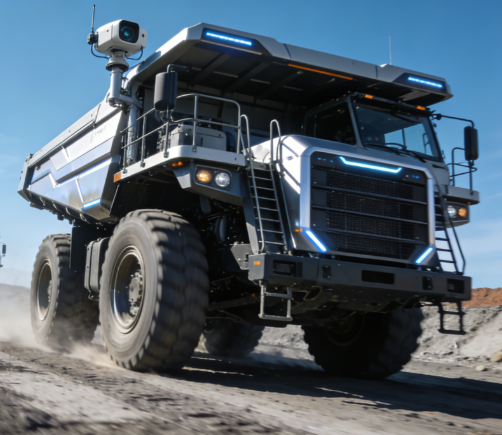
Komatsu’s proven Autonomous Haulage System (AHS), which has logged over 10 billion tons of material hauled in mining operations, is now being deployed for the first time in large-scale construction projects. At the $12 billion Red Sea Gateway port expansion in Saudi Arabia, a fleet of 15 autonomous HD785-8 dump trucks is operating 24/7, delivering materials with 15% higher productivity than manned operations while achieving a 100% safety record over six months. This marks a pivotal shift in how heavy construction projects leverage autonomy to overcome labor shortages and enhance operational resilience.
In partnership with Tokyo-based utility TEPCO, Komatsu will launch a pilot of its battery-electric PC210E excavator in Q3 2026 for urban construction projects in Japan. The 20-tonne excavator, powered by a 450kWh lithium-ion battery, delivers equivalent performance to its diesel counterpart while producing zero emissions at the point of use. The pilot will test a rapid-swap battery system, enabling 5-minute battery swaps to maximize uptime, a critical step toward making electric heavy machinery viable for dense urban environments.
Additionally, Komatsu has delivered the first batch of its hybrid-powered WA475-10 wheel loaders to European construction firms. Equipped with a Komatsu Hybrid System that recovers energy during deceleration, the loaders reduce fuel consumption by up to 25% and cut CO₂ emissions, aligning with the EU’s ambitious carbon reduction targets for the construction sector.
At the 2026 Bauma China exhibition, Komatsu expanded its collaboration with Microsoft to embed Azure AI into its global fleet of construction and mining equipment. The company debuted Komatsu Smart Care, a cloud-based platform that uses real-time sensor data and machine learning to predict component failures up to 30 days in advance, reducing unplanned downtime by an estimated 40%. This integration leverages Microsoft’s Azure IoT Hub for edge computing, enabling safer, more efficient operations in remote and challenging environments.
Komatsu is also building digital twins of its manufacturing facilities using Microsoft Azure Digital Twins, optimizing production lines to reduce waste and improve the recyclability of its equipment, a key pillar of its circular economy strategy.
Komatsu’s next-generation SAA6D170E-7 engine platform, scheduled for production in 2027, will support 100% renewable fuels, including hydrogenated vegetable oil (HVO) and biodiesel, for its line of mining trucks and bulldozers. The inline six-cylinder engine delivers 10% more power while reducing NOₓ emissions by 90% compared to previous models, targeting applications such as open-pit mining and large-scale earthmoving. This initiative aligns with Komatsu’s goal to achieve carbon neutrality in its operations by 2030 and across its value chain by 2050.
Komatsu remains at the forefront of heavy machinery innovation, combining proven durability with next-generation technology to empower customers in building a more sustainable and productive future.